
Why High End Audio Sounds Organic: A Full Guide
Table of Contents
- What 'Organic' Actually Means in High End Audio
- What Is High Fidelity Audio and Why Does It Sound Different
- The Signal Path: Where Organic Sound Is Won or Lost
- The Psychoacoustics Behind Why High End Audio Sounds Organic
- How to Improve Audio Soundstage and Imaging in Your System
- Source Material Quality: The Foundation of Organic Sound
- Why Poorly Mixed Music Exposes the Truth About Your System
- Frequently Asked Questions
Last Updated: August 30, 2026
What 'Organic' Actually Means in High End Audio
Most audiophiles use the word "organic" constantly without defining it. At Wyred 4 Sound, we hear it from customers every week, and the question behind it is always the same: why does high end audio sound like music while cheaper gear sounds like a recording?
Organic sound is the quality of audio reproduction that closely mirrors the tonal, textural, and temporal characteristics of a live acoustic performance. It is not a single measurable parameter but the perceptual result of many technical factors working together without introducing artifacts that the ear recognizes as unnatural.
Timbre, Texture, and the Sound of Real Instruments
Timbre is the reason a violin and a flute playing the same note sound different. It is defined by the harmonic overtone structure layered above the fundamental frequency. High end audio systems reproduce those overtone structures with far greater accuracy than consumer gear. When harmonic distortion is low and frequency response is flat and extended, the timbre of instruments arrives intact. You hear not just the note but the body of the instrument producing it. Consumer systems often roll off high frequencies or introduce coloration in the midrange, producing a flattened, homogenized sound that feels processed rather than present.
Musicality vs. Clinical Accuracy: Why Both Matter
The audiophile community often splits into camps treating musicality and accuracy as opposites, but both sides are partially right. Clinical accuracy means flat frequency response, low distortion, and measurable neutrality. Musicality refers to emotional engagement. The best high end audio systems are both accurate and musical, they are musical precisely because they are accurate. When a system stops adding its own coloration, the music's inherent expressiveness comes through. A system that sounds "warm" by rolling off the top end is not musical; it is colored, a form of distortion even if pleasant.
What Is High Fidelity Audio and Why Does It Sound Different
High fidelity audio is the reproduction of sound with such accuracy that the listener cannot distinguish the playback from the original performance. The gap between high fidelity and consumer audio comes down to engineering tolerance. Every component in a consumer system is built to a price point. Every component in a high fidelity system is built to a performance specification.
Frequency Response, Dynamic Range, and Noise Floor
Three measurements separate high fidelity from mass-market audio.
Frequency response describes how evenly a system reproduces all audible frequencies, roughly 20 Hz to 20 kHz. A flat response means a violin sounds like a violin. A colored response means it sounds like your system's interpretation of a violin.
Dynamic range is the difference between the softest and loudest sounds a system can reproduce. Live music has enormous dynamic range. Compressing it removes the contrast that makes music feel alive. The sudden swell of an orchestra, the silence before a snare hit: these dynamic events are crucial.
Noise floor is the baseline level of electrical noise in the signal chain. A high noise floor masks micro-details: the breath of a flautist, the subtle reverb tail of a guitar in a large room. Lowering the noise floor reveals information that was always in the recording but buried.
According to the Audio Engineering Society's technical standards documentation, noise floor and dynamic range are among the most critical specifications for evaluating audio equipment performance.
How Bit Depth and Sampling Rate Affect Perceived Naturalness
Digital audio captures sound by sampling the analog waveform at discrete intervals. Bit depth determines how many amplitude levels each sample can represent. Sampling rate determines how many samples per second are captured.
A 16-bit, 44.1 kHz file (standard CD quality) captures substantial detail. A 24-bit, 96 kHz file captures more. In a high-resolving system, higher bit depth reduces quantization noise and improves the rendering of low-level detail where much of the organic quality of music lives. The critical variable is the quality of the digital-to-analog conversion that turns those bits back into sound.
The Signal Path: Where Organic Sound Is Won or Lost
The signal path is the complete chain of components a signal travels through from source to speaker. Every component either preserves the signal or degrades it. There is no neutral position.
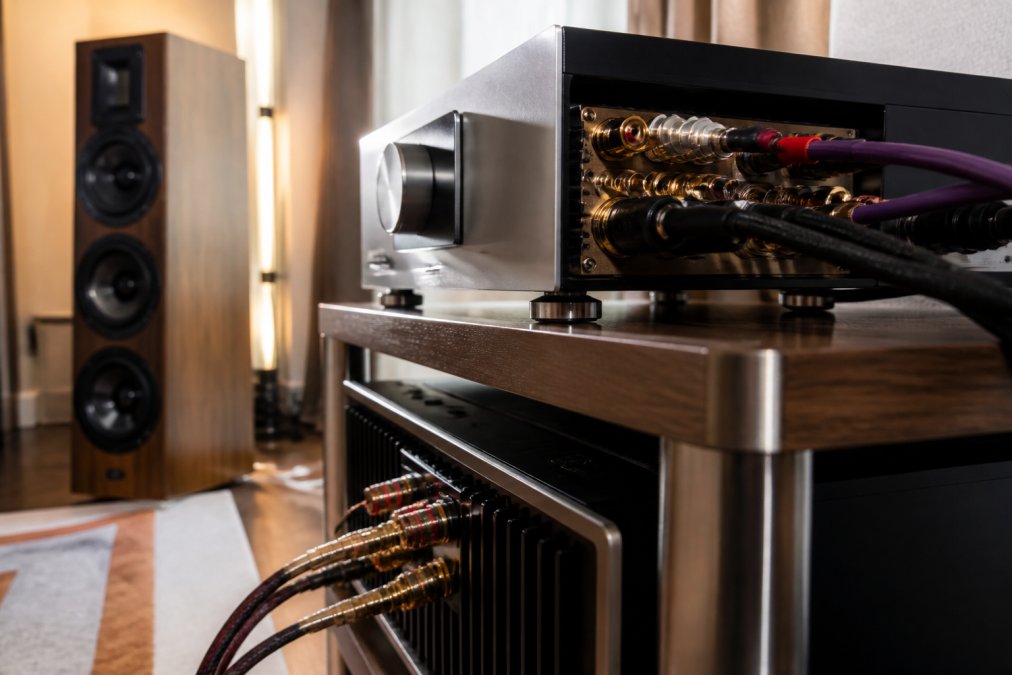
Most people focus on speakers and amplifiers. The more common failure point is earlier in the chain: the digital-to-analog converter. A poor DAC introduces jitter, smears transient information, and raises the noise floor. No amplifier or speaker can recover information lost at the conversion stage.
Harmonic Distortion, Jitter, and Signal-to-Noise Ratio
Three specific measurements define signal path quality.
Harmonic distortion is the addition of overtones not present in the original signal. Low levels of harmonic distortion, particularly even-order harmonics, are often described as warmth. Higher levels of odd-order harmonic distortion are perceived as harshness. High end components minimize both.
Jitter is timing error in digital audio. When the clock governing digital-to-analog conversion is imprecise, samples are converted at slightly wrong intervals, smearing spatial information and reducing imaging precision. Dedicated reclockers and precision clocking circuits address this directly.
Signal-to-noise ratio measures the level of the desired signal relative to background noise. A high signal-to-noise ratio means the music sits well above the noise floor, producing greater perceived clarity and a more defined soundstage.
Digital vs. Analog Sound Signatures
Neither digital nor analog is inherently superior. Both can sound organic when implemented well. Analog systems introduce their own distortions: wow and flutter, surface noise, frequency response variations. These can be pleasant, which is why vinyl has a devoted following.
Digital systems, when poorly implemented, introduce jitter, quantization artifacts, and a sterile edge. When implemented well, with a high-quality DAC and precise clocking, digital audio can be extraordinarily transparent. The signal-to-noise ratio of a well-designed digital system often exceeds what analog can achieve. Transparency, the quality of getting out of the way of the music, is achievable in both domains.
The Psychoacoustics Behind Why High End Audio Sounds Organic
Psychoacoustics is the scientific study of how humans perceive sound. The ear is not a microphone but an extraordinarily complex biological instrument that applies pattern recognition, temporal processing, and contextual interpretation to everything it hears. High end audio systems succeed partly because they give the auditory system enough information to complete that process accurately.
As documented in research published by the Acoustical Society of America, the human auditory system is sensitive to timing differences as small as a few microseconds, which directly explains why jitter and transient accuracy have audible consequences even when the errors are technically tiny.
Micro-Details, Transient Response, and Listening Fatigue
Micro-details are the low-level sonic events embedded in a recording: room reflections, the mechanical noise of a piano action, subtle pitch variations of a vocalist. These details are not consciously noticed but the brain processes them continuously. When micro-details are present and accurate, the brain constructs a coherent spatial model of the performance, producing a convincing sense of place and presence. When they are missing or distorted, the brain works harder, producing listening fatigue.
Listening fatigue is a measurable phenomenon with a physiological basis. High end audio reduces it by giving the auditory system complete, coherent information.
Transient response is the system's ability to reproduce sudden changes in amplitude accurately. A snare hit, a piano attack, a plucked string: these transient events define rhythm and pace. Poor transient response smears them, reducing the sense that music feels alive.
Expectation Bias and Measurement-Based Validation
Expectation bias is real. Knowing you are listening to expensive equipment makes it sound better. Blind listening tests show that the gap between subjective and objective evaluation is significant. Both matter: measurements tell you what a system is doing; listening tells you how it sounds. The most credible high end audio manufacturers publish their measurements and invite scrutiny. As examined in Stereophile's measurement methodology documentation, objective measurement and subjective listening are complementary tools.
How to Improve Audio Soundstage and Imaging in Your System
Soundstage is the perceived three-dimensional space in which instruments appear during playback. Imaging is the precision with which individual instruments are located within that space. Together, they create the sense that music exists in a physical environment rather than emanating from two boxes.
Factor |
What It Affects |
Priority |
|---|---|---|
Speaker placement |
Soundstage width and depth |
High |
Room acoustics |
Imaging precision and coherence |
High |
DAC quality |
Spatial information retrieval |
High |
Amplifier matching |
Dynamic coherence |
Medium |
Cable quality |
Noise floor, signal integrity |
Medium |
Source material resolution |
Available spatial data |
High |
Room Acoustics and Speaker Placement
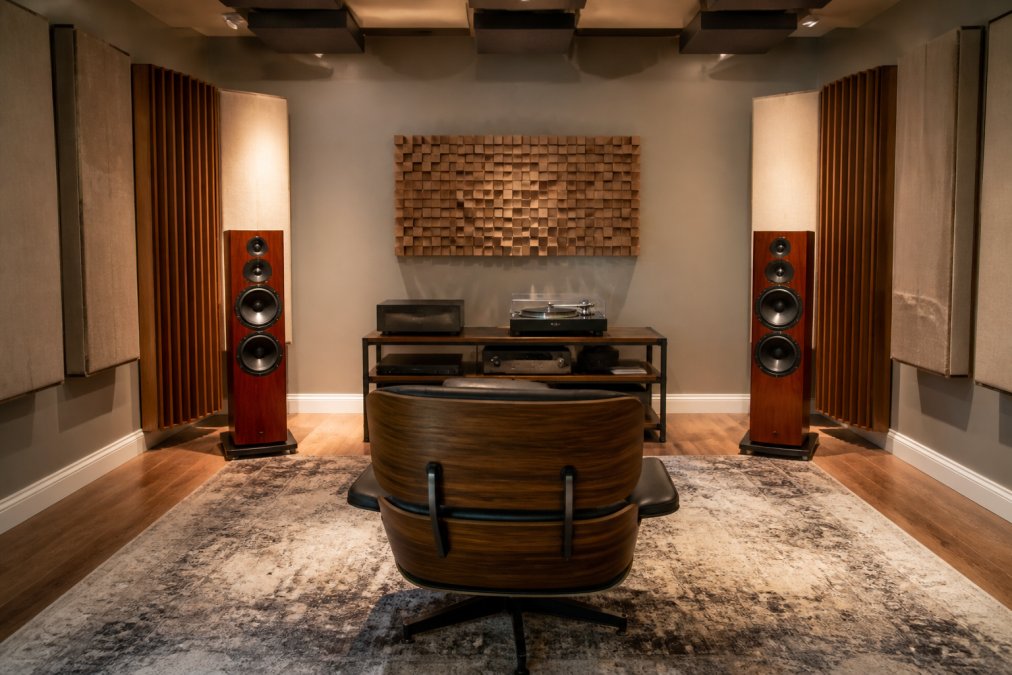
The room is the most underestimated component in any audio system. Untreated parallel walls create standing waves that add resonances not present in the recording. Early reflections from side walls blur imaging. Bass buildup in room corners masks low-frequency detail.
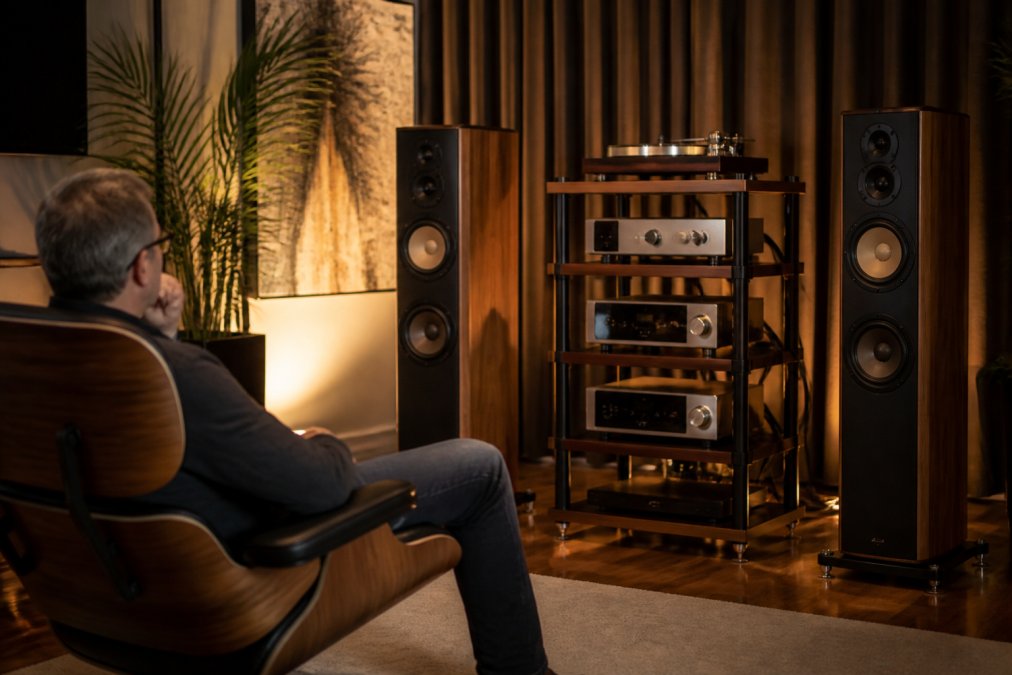
Most speakers perform best when pulled at least one meter from the rear wall and toed in toward the listening position. The listening chair should sit at the apex of an equilateral triangle formed with the two speakers. Acoustic treatment, absorption panels at first reflection points and bass traps in corners, makes a measurable and audible difference. A treated room allows a modest system to outperform an expensive system in an untreated one.
Component Matching and the Role of DACs
A common mistake is matching components by price rather than by electrical compatibility. Amplifier input impedance, DAC output impedance, and cable capacitance all interact. A mismatch can produce frequency response anomalies that no amount of room treatment will fix.
The DAC is the most consequential upgrade in a digital system. A high-quality DAC with low jitter, a low noise floor, and accurate frequency response retrieves spatial information from the recording that cheaper converters discard. The improvement in soundstage width and imaging precision is often the first thing listeners notice.
Source Material Quality: The Foundation of Organic Sound
No system, regardless of quality, can retrieve information that was never recorded. A heavily compressed streaming file played through a world-class system will sound like a heavily compressed streaming file. High-resolution audio files provide more raw information for a high end system to work with. The difference is most audible in spatial information: soundstage depth, imaging precision, and the sense of the recording space. Invest in source quality alongside hardware quality. A high-resolution file through a good DAC will consistently outperform a compressed file through an excellent one.
Why Poorly Mixed Music Exposes the Truth About Your System
A high end audio system is a precision instrument that does not flatter recordings. A poorly mixed track, one with harsh digital clipping, narrow stereo image, or unnatural tonal balance, will sound exactly that way through a transparent system. A colored, euphonic system may make it sound acceptable.
This is not a flaw. It is the point. The goal of high fidelity is accuracy. A system that makes bad recordings sound good is not high fidelity; it is a pleasant distortion machine. The test of a truly organic-sounding system is that it makes great recordings sound extraordinary and reveals the weaknesses of poor ones. That transparency is what the audiophile pursuit is actually about.
Wyred 4 Sound components are engineered to this standard: precision DACs, amplifiers, and music servers designed to get out of the way of the signal and let the recording speak for itself. The Audiophilia Star Component and 6moons Blue Moon awards the brand has received reflect that commitment to transparency over coloration.
Building a system that sounds genuinely organic requires attention to every link in the signal chain, from source file quality to room acoustics. Wyred 4 Sound designs its digital-to-analog converters, reclockers, and precision power solutions specifically to address the technical factors, jitter, noise floor, harmonic distortion, that stand between a recording and an organic listening experience. If you are ready to hear what your music actually sounds like, subscribe to the Wyred 4 Sound newsletter for component guides, system-building advice, and updates on new products built to the same uncompromising standard.
Frequently Asked Questions
What does 'organic' mean in the context of high-end audio?
In high-end audio, 'organic' describes sound that feels natural, unforced, and true to the original performance. It means instruments have realistic timbre and texture, transients decay naturally, and the soundstage has coherent spatial information. The opposite is sound that feels processed, sterile, or artificially sharp. Achieving an organic quality depends on low harmonic distortion, a clean signal path, accurate frequency response, and source material with sufficient bit depth and sampling rate to preserve what the recording engineer captured.
How do digital-to-analog converters influence the naturalness of sound?
A DAC converts digital data into an analog signal your amplifier and speakers can reproduce. A poorly designed DAC introduces jitter, raises the noise floor, and adds coloration that smears micro-details and compresses dynamic range. A high-quality DAC minimizes these artifacts, preserving the transparency and warmth of the original recording. The difference is most audible on complex passages where multiple instruments overlap — a resolving DAC keeps each voice distinct rather than blending them into a flat, two-dimensional image.
Does high-resolution audio actually sound more organic than standard formats?
High-resolution audio, recorded at higher bit depth and sampling rates than standard CD quality, preserves more of the spatial information and transient detail from the original session. Whether that difference is audible depends on your playback chain. If your DAC, amplifier, and speakers cannot resolve fine detail, the advantage is lost. On a well-matched high-fidelity system, the improvement in dynamic range and noise floor reduction is real and measurable, and most listeners describe the result as more open, natural, and three-dimensional.
Why do high-end systems provide a better sense of soundstage and imaging?
Soundstage and imaging depend on the system's ability to reproduce tiny timing and level differences between channels without adding distortion or noise. High-end components maintain a low noise floor and high signal-to-noise ratio, so the subtle spatial cues embedded in a recording survive intact. Room acoustics play an equally important role — even a resolving system loses its imaging advantage in an untreated room. Proper speaker placement, acoustic panels, and component matching all contribute to a wide, deep, and precisely focused soundstage.