Best DAC for Audiophile Systems: A 2026 Guide
Table of Contents
- What Is a DAC and Why Your Audiophile System Needs One
- DAC Comparison Table: Key Specs at a Glance
- How to Choose a DAC for Home Audio: Selection Criteria
- Balanced vs. Unbalanced DAC Outputs: Which Matters for Your Setup
- External DAC vs. Internal DAC: When to Upgrade
- Top DACs for Audiophile Systems Across All Budgets
- Connectivity Options: USB, Optical, Coaxial, and XLR Explained
- Firmware Support and Long-Term Reliability in Audiophile DACs
- Frequently Asked Questions
Last Updated: September 3, 2026
What Is a DAC and Why Your Audiophile System Needs One
A digital-to-analog converter (DAC) transforms digital audio files into analog signals your amplifier and speakers can reproduce. Without a DAC, your system cannot play digital content. A mediocre DAC introduces artifacts, distortions, jitter, and noise that erode clarity and soundstage, while a well-engineered DAC acts as a transparent window into your music.
Most audiophiles don't realize their integrated amplifier already contains a DAC, but these onboard converters are often built to cost rather than perform. This is why upgrading to a standalone best dac for audiophile systems often yields significant sonic improvement.
At Wyred 4 Sound, we've engineered DACs for over a decade with one obsession: eliminating the digital artifacts that prevent listeners from hearing what the artist intended. The difference between a generic converter and a reference-grade DAC is the gap between hearing your music and experiencing it.

DAC-1v2
DAC Comparison Table: Key Specs at a Glance
Model |
Price |
DAC Chip |
Max Resolution |
Balanced Output |
Best For |
|---|---|---|---|---|---|
$399 |
ESS Sabre |
24-bit/192kHz |
RCA only |
Budget entry point, small systems |
|
$499 |
ESS Sabre |
24-bit/192kHz |
RCA + headphone amp |
Portable + desktop flexibility |
|
$1,299 |
ESS Sabre 9026PRO |
32-bit/384kHz + 4xDSD |
XLR balanced |
Mid-range reference quality |
|
$3,799 |
ESS Sabre 9038PRO |
32-bit/384kHz + 4xDSD |
XLR balanced |
Flagship performance value |
|
$4,499 |
ESS Sabre 9038PRO |
32-bit/384kHz + 4xDSD |
XLR balanced |
Limited-edition reference standard |
How to Choose a DAC for Home Audio: Selection Criteria
Choosing the right DAC depends on your system architecture, listening priorities, and the resolution standards your music library uses. Start by identifying your digital source, streaming, computer files, or CD transport, as each introduces different timing challenges. Next, examine your amplifier's input stage: balanced (XLR) inputs offer superior noise rejection and longer cable runs compared to unbalanced (RCA).
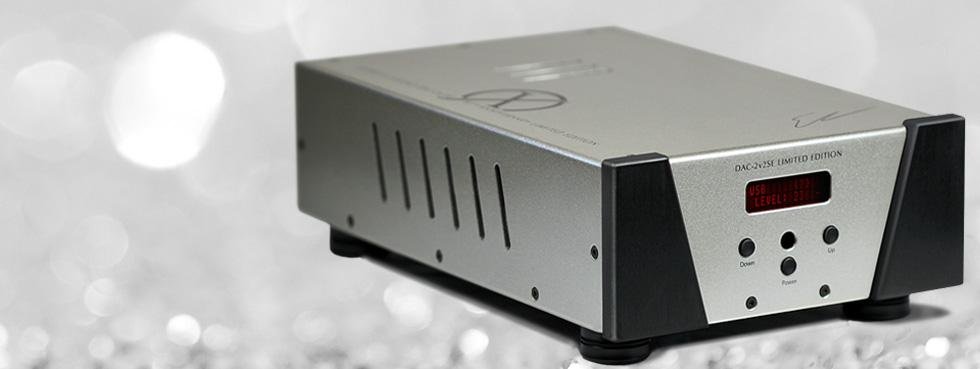
DAC-2v2SE 10th Anniversary Limited Edition
Bit Depth, Sample Rate, and Jitter Control
Bit depth determines sample resolution, while sample rate defines samples per second. Standard CD-quality audio uses 16-bit/44.1kHz (peer-reviewed research). High-resolution audio starts at 24-bit/96kHz and extends to 32-bit/384kHz (aes.org). Many streaming services now offer 24-bit/96kHz or higher, making high-resolution DAC capability genuinely useful.
Beyond 24-bit/96kHz, practical benefit depends on your listening environment and ear sensitivity. A 32-bit/384kHz DAC is more future-proof and often uses superior internal architecture, but your actual listening experience may not change dramatically if you're primarily streaming 24-bit/96kHz content. The engineering that enables those specs, better clocking, lower noise floors, superior output stages, is what actually matters.
Jitter is timing error in the digital clock that causes samples to be read at slightly wrong moments, introducing phase distortion and a veil over the soundstage. High-quality DACs use femtosecond-grade clocks to minimize jitter.
DAC Chip Architecture: Sabre vs. R-2R
Delta-sigma DACs like the ESS Sabre 9038PRO use aggressive oversampling and noise shaping to push quantization noise outside the audible band. They offer exceptional measured specs with signal-to-noise ratio exceeding 120dB and total harmonic distortion under 0.001%.
R-2R ladder networks use precision resistor networks to convert digital values directly to analog without oversampling. They require hand-matched components and meticulous design, making them expensive and less common in affordable performance DACs.
For most listeners, Sabre-based DACs offer superior measured performance, greater flexibility, and better value. Wyred 4 Sound uses ESS Sabre architecture across our entire lineup because the engineering excellence and sonic transparency align with our design philosophy.
Balanced vs. Unbalanced DAC Outputs: Which Matters for Your Setup
Balanced outputs (XLR connectors) transmit the audio signal on three pins: hot, cold, and ground. The amplifier inverts the cold signal and sums both channels, canceling any noise picked up along the cable. This allows longer cable runs without degradation, typically 20+ feet.
Unbalanced outputs (RCA connectors) use a single hot pin and shared ground. They're adequate for short cable runs under 6 feet. Beyond that distance, they become susceptible to electromagnetic interference.
If your DAC and amplifier are within arm's reach, unbalanced RCA is fine. If your DAC sits 15 feet from your amplifier, balanced XLR is necessary.
External DAC vs. Internal DAC: When to Upgrade
Your amplifier already contains a DAC. The question is whether that internal converter is limiting your system's potential.
Internal DACs are engineered to cost rather than perform. Manufacturers allocate budget to amplification and features, treating the DAC as an afterthought, resulting in higher distortion, greater jitter, and narrower soundstage compared to dedicated external converters.
External DACs isolate the conversion process in a dedicated component with its own power supply, clocking, and output stages, eliminating electrical noise that digital circuitry generates.
If your current system sounds veiled, compressed, or lacking fine detail, especially with high-resolution files, an external DAC will likely improve things. An external DAC can often yield more sonic benefit than amplifier upgrades in the same price range.
Top DACs for Audiophile Systems Across All Budgets
Budget-Friendly Option: µDAC at $399
The µDAC proves exceptional sound doesn't require a four-figure investment. At 3.5" × 3.5" × 1.25", this compact converter uses ESS Sabre technology derived from our larger flagship designs. It handles 24-bit/192kHz PCM via S/PDIF inputs and asynchronous USB.
This is the entry point into Wyred 4 Sound's lineup, ideal for upgrading from your amplifier's internal converter or building a second system. It accepts two S/PDIF inputs (coaxial and optical) plus USB. The limitation is straightforward: no balanced output, no headphone amplifier, and no DSD support. For streaming 24-bit/96kHz from a music server or playing Spotify through a computer, the µDAC delivers clean, transparent sound.
Mid-Range Performer: DAC-1v2 at $1,299
The DAC-1v2 is where Wyred 4 Sound's engineering philosophy reaches critical mass. You get the ESS Sabre 9026PRO chip, regarded as one of the best price-to-performance converters available, paired with our proprietary discrete output stages and a hefty balanced power supply.
This DAC handles 32-bit/384kHz PCM and 4xDSD natively via galvanically isolated USB. The balanced XLR outputs allow longer cable runs and lower output impedance. Add the optional femto-grade clock upgrade, and you've reduced phase jitter, a specification typically found in DACs retailing for $5,000 or more.
The DAC-1v2 is the sweet spot for most serious listeners, powerful enough to serve as the centerpiece of a reference system yet affordable enough that upgrading later doesn't feel wasteful.
Reference-Grade: DAC-2v2SE at $3,799
The DAC-2v2SE is our flagship, built on the principle of no compromise. At its heart sits the ESS Sabre 9038PRO, the best DAC chip on the market with respect to both measured specs and sonic performance. The DAC-2v2SE includes Vishay Z-Foil resistors (precision-matched to 0.1%), ultra-low noise discrete regulators, ultra-fast recovery Schottkey diodes, and premium-grade inductors throughout. The femto-grade clock reduces phase jitter, delivering the transparency that separates reference-grade converters from merely good ones. The result is a DAC that has won multiple industry awards for performance and value.
This is the DAC for listeners who want to stop upgrading and start enjoying.
Flagship Anniversary Edition: DAC-2v2SE 10th Anniversary at $4,499
To celebrate our tenth anniversary in 2026, we've created the DAC-2v2SE 10th Anniversary Limited Edition. Building on the flagship DAC-2v2SE, this commemorative piece represents the culmination of a decade of engineering expertise, using only the highest-grade parts and distinctive exterior features.
The 10th Anniversary uses the same ESS Sabre 9038PRO chip and femto-grade clock as the standard DAC-2v2SE, but with further refinements in component selection and circuit topology. The result is measurably lower noise floor, greater dynamic range, and a soundstage that feels almost three-dimensional in its depth and precision. Limited production run means ownership is exclusive.
Connectivity Options: USB, Optical, Coaxial, and XLR Explained
Your DAC's connectivity determines how it integrates with your system and what sources it can accept.
USB (Asynchronous) is the modern standard for computer and music server connections. Asynchronous USB means the DAC controls the data flow rate rather than the computer, eliminating timing errors that introduce jitter. Galvanic isolation, a transformer that breaks the electrical connection between your computer and DAC, prevents computer noise from coupling into your audio path. All Wyred 4 Sound DACs with USB support asynchronous transfer and galvanic isolation as standard.
Optical (TOSLINK) uses light pulses to transmit digital audio, providing complete electrical isolation between source and DAC. This makes optical excellent for reducing hum and noise from sources like DVD players or streaming devices. Optical maxes out at 24-bit/96kHz due to physical transmission limits (aes.org).
Coaxial (S/PDIF) transmits digital audio via a standard RCA-style connector using electrical signals. It supports up to 24-bit/192kHz and is common on CD transports. Coaxial is susceptible to jitter, so it's best reserved for shorter cable runs under 6 feet.
XLR (AES/EBU) is the professional standard for digital audio transmission, using balanced connections that reject noise. It supports 24-bit/192kHz and is found primarily on high-end CD transports.
For most home systems, USB from a music server or computer is optimal.
Firmware Support and Long-Term Reliability in Audiophile DACs
Wyred 4 Sound designs for longevity. Our DACs use standard digital inputs (USB, S/PDIF, AES/EBU) that will remain relevant for decades. We don't rely on proprietary software or cloud-dependent features that become obsolete when a company changes direction.
Firmware updates matter for USB driver compatibility. As operating systems evolve, DACs sometimes need driver updates to maintain compatibility with new versions of Windows or macOS. Wyred 4 Sound provides firmware updates for all current products, ensuring your DAC remains compatible with modern systems.
The real reliability test is power supply design and component selection. Wyred 4 Sound uses hefty linear power supplies with quality capacitors and voltage regulation engineered for long-term operation. We don't use switching power supplies that generate noise, and we don't cut corners on passive components.
When evaluating any DAC, ask: Does the manufacturer support older products with firmware updates? Do they use standard connectors and protocols? Is the power supply strong? These questions predict whether your investment will sound good in the long term.
Choosing the best DAC for audiophile systems requires matching the converter's capabilities to your source material, your amplifier's inputs, and your listening priorities. The µDAC delivers exceptional value at entry-level prices. The DAC-1v2 is the sweet spot for most serious listeners. The DAC-2v2SE offers reference-grade performance at a compelling price. The DAC-2v2SE 10th Anniversary represents the absolute best we can engineer.

DAC-2v2 Series
Wyred 4 Sound's DACs share a common design philosophy: eliminate digital artifacts, preserve transparency, and build for longevity. Start with the model that matches your budget and system, then upgrade when your ears tell you the time is right. The improvement from a quality external DAC is often the most dramatic upgrade you'll experience in your audio journey.
Frequently Asked Questions
What is the best DAC for audiophile systems in 2026?
The best DAC depends on your budget and system architecture. For reference-grade performance, the DAC-2v2SE at $3,799 delivers state-of-the-art sound with the ESS 9038PRO chip, balanced circuitry, and support for PCM up to 32-bit/384kHz and quad DSD. For those seeking the ultimate, the DAC-2v2SE 10th Anniversary Limited Edition at $4,499 adds premium components and upgraded clocking. Budget-conscious audiophiles should consider the DAC-1v2 at $1,299, which offers excellent price-to-performance with the ESS 9026PRO chip.
How do I choose a DAC for home audio that matches my existing system?
Start by identifying your digital source: streaming, USB from a computer, or optical/coaxial connections. Check your amplifier's input requirements—balanced XLR inputs accept higher signal levels with better noise rejection than unbalanced RCA. Consider whether you need volume control (useful if eliminating a preamp) or preamp mode (if you already have one). Evaluate your room size and listening distance; larger rooms can benefit from DACs with lower jitter and higher dynamic range. Finally, match the DAC's connectivity to your sources and ensure it supports your preferred audio formats (PCM, DSD, MQA).
Should I use a balanced or unbalanced DAC output in my setup?
Balanced outputs (XLR) are superior for longer cable runs and professional environments because they reject electromagnetic interference more effectively, resulting in lower noise floors and clearer sound. Unbalanced outputs (RCA) work well for shorter runs (under 15 feet) in residential settings. If your amplifier has balanced inputs, use them—you'll gain 6dB of headroom and better channel separation. Most high-end DACs like the DAC-2v2SE include both options, so you can choose based on your amplifier's design and cable length.
Do I need an external DAC if my amplifier already has one built in?
An external DAC improves sound quality if your amplifier's internal converter uses budget components or lacks support for high-resolution formats. Built-in DACs often prioritize cost savings over audio performance. A dedicated external DAC like the DAC-1v2 or DAC-2v2SE isolates the conversion from the amplifier's power supply noise and uses superior DAC chips, resulting in lower jitter, higher signal-to-noise ratio, and more transparent sound. If your amplifier is entry-level, upgrading to an external DAC is one of the most cost-effective improvements you can make.
Is it worth investing in an expensive high-end DAC for a home audio system?
Yes, if your system components justify it. A quality DAC eliminates digital artifacts and jitter, allowing your speakers and amplifier to perform at their potential. In systems with good speakers and amplification, upgrading from a budget DAC to a reference-grade model like the DAC-2v2SE reveals improvements in soundstage, imaging, transparency, and dynamic range. However, ensure your entire chain is balanced—a $4,000 DAC won't overcome poor speakers or inadequate amplification. For discerning listeners with dedicated listening rooms and quality components, the investment pays dividends in listening enjoyment.