
Best High End Amplifier Brands: 2026 Guide
Table of Contents
- What Makes a High End Amplifier Worth the Price
- Class A vs Class AB vs Class D Amplifiers Explained
- Monoblock vs Stereo Amplifiers Explained
-
High End Amplifier Brands and Models Compared
- Wyred 4 Sound ST mkIII Series, Best Stereo Amp Under $2,000
- Wyred 4 Sound STI-v2 Series, Best Integrated Amplifier for Purists
- Wyred 4 Sound SX-1000R, Best Monoblock for Demanding Speakers
- Wyred 4 Sound mAMP, Best Entry Monoblock for High-Fidelity Systems
- Wyred 4 Sound mINT, Best Compact Integrated with Built-In DAC
- High-End Audio Component Matching: Speakers, Sources, and Cabling
- Power Efficiency, Heat Management, and Blind Test Methodology
- Which High End Amplifier Should You Buy?
- Frequently Asked Questions
Last Updated: September 2, 2026
Choosing the best high end amplifier brands is one of the most consequential decisions an audiophile makes. The amplifier sits at the heart of every high-fidelity system, determining whether your speakers perform at their ceiling or fall short of it. At Wyred 4 Sound, we've spent years engineering amplifiers that prove high-end audio performance doesn't require a second mortgage. Below, we break down what separates a reference-grade amplifier from a glorified receiver, compare our full lineup across form factors and power levels, and give you a clear framework for matching amplification to your specific speakers, room, and source components.
The honest truth most guides skip: topology matters more than wattage, and component synergy matters more than either.
Quick Picks:
- Best Stereo Amp Under $2,000: Wyred 4 Sound ST mkIII Series ($1,879), ICEedge topology, exceptional transient response
- Best Integrated Amplifier: Wyred 4 Sound STI-v2 Series ($2,499), reference preamp stage, two mono amps in one chassis
- Best Monoblock for Demanding Speakers: Wyred 4 Sound SX-1000R ($1,499/each), stable to 2 ohms
- Best Entry Monoblock: Wyred 4 Sound mAMP ($999/each), award-winning, micro-dynamic transparency
- Best Compact Integrated with DAC: Wyred 4 Sound mINT ($1,499), ESS DAC, 24-bit/192kHz, 100W per channel
What Makes a High End Amplifier Worth the Price
A high end amplifier is worth its price when it delivers measurably lower distortion, higher signal-to-noise ratio, tighter impedance control, and build quality that maintains those figures over a decade of use. The difference between a $300 receiver and a $1,500 reference amplifier is audible on any well-resolving speaker.

Key Performance Metrics: SNR, Damping Factor, and THD
Three numbers tell you most of what you need to know about an amplifier's technical performance.
Signal-to-Noise Ratio (SNR) measures the gap between the audio signal and the noise floor. A well-engineered high-fidelity amplifier achieves an SNR above 100dB, making noise effectively inaudible during quiet passages (aes.org). Lower-grade amplifiers introduce hiss and hum that compresses perceived dynamic range.
Total Harmonic Distortion (THD) quantifies how faithfully the amplifier reproduces the original signal. THD below 0.1% is the threshold for transparency; reference-grade designs push well below that (peer-reviewed research). The Wyred 4 Sound mAMP uses audio-grade capacitors and a quad-paralleled FET buffer specifically to reduce THD at the source.

Damping factor is the ratio of speaker impedance to amplifier output impedance. A high damping factor, typically above 100, gives the amplifier tight control over woofer cone movement, producing defined bass rather than bloated. This matters especially with low-impedance speakers.
Build Quality, Power Supply Design, and Long-Term Serviceability
The power supply is where most budget amplifiers compromise. A poorly designed power supply introduces noise into the signal path, limits dynamic headroom, and degrades under thermal stress. Reference designs use oversized transformers, high-quality filter capacitors, and dedicated regulation stages for the input circuitry. Wyred 4 Sound builds domestically and supports its products with an active service department, meaning your investment remains relevant and repairable years after purchase.
Class A vs Class AB vs Class D Amplifiers Explained
Amplifier topology defines how the output devices handle the audio signal, and each involves a real tradeoff between sound character, power efficiency, and heat management.
Class A amplifiers bias their output transistors to conduct continuously, eliminating crossover distortion entirely and producing the warmest, most linear sound signature. The cost: Class A designs run hot and consume significant power even at idle, making them impractical above 50W.
Class AB splits the difference. Output devices conduct for slightly more than half the signal cycle, reducing crossover distortion compared to pure Class B while recovering much of the efficiency lost in Class A. Most traditional solid-state high-end amplifiers use Class AB.
Class D amplifiers use high-frequency switching to reconstruct the audio signal, achieving efficiency figures above 90% while generating minimal heat. The ICEpower ICEedge topology used in the Wyred 4 Sound ST mkIII Series represents the current state of Class D engineering: switching frequencies high enough that the output filter operates well above the audible band, preserving harmonic structure and transient response.

| Topology | Efficiency | Heat Output | Sound Character | Best For |
|---|---|---|---|---|
| Class A | Low (20-30%) | Very High | Warm, zero crossover distortion | Low-power, nearfield listening |
| Class AB | Medium (50-70%) | Moderate | Neutral to warm, low distortion | Traditional high-end stereo |
| Class D (ICEedge) | Very High (90%+) | Low | Transparent, extended dynamics | High-power, thermally constrained installs |
Monoblock vs Stereo Amplifiers Explained
A monoblock amplifier dedicates an entire chassis to a single channel, eliminating crosstalk between channels entirely and allowing the power supply to focus all its reserves on one speaker. For demanding speakers with complex, low-impedance crossovers, monoblocks provide a stability advantage that stereo amplifiers can't match.
A stereo amplifier houses both channels in a single chassis. The practical advantages are real: one power cable, one set of interconnects, less rack space, and lower total cost for equivalent power. For speakers with benign impedance curves and sensitivity above 87dB, a well-designed stereo amplifier provides everything a monoblock does at a lower price point.
Monoblocks win when speakers are difficult loads or when the listening room demands sustained high-power output. The channel separation advantage of monoblocks becomes measurably significant below 4 ohms, which is exactly the operating range of many planar, electrostatic, and multi-driver tower speakers.
High End Amplifier Brands and Models Compared
Wyred 4 Sound's lineup covers every major amplifier form factor, from compact integrated units to full monoblock pairs, all built around ICEpower's Class D topology with custom input stages. Every model uses 14AWG OFC wiring, gold-plated binding posts, and dual differential common mode converters.
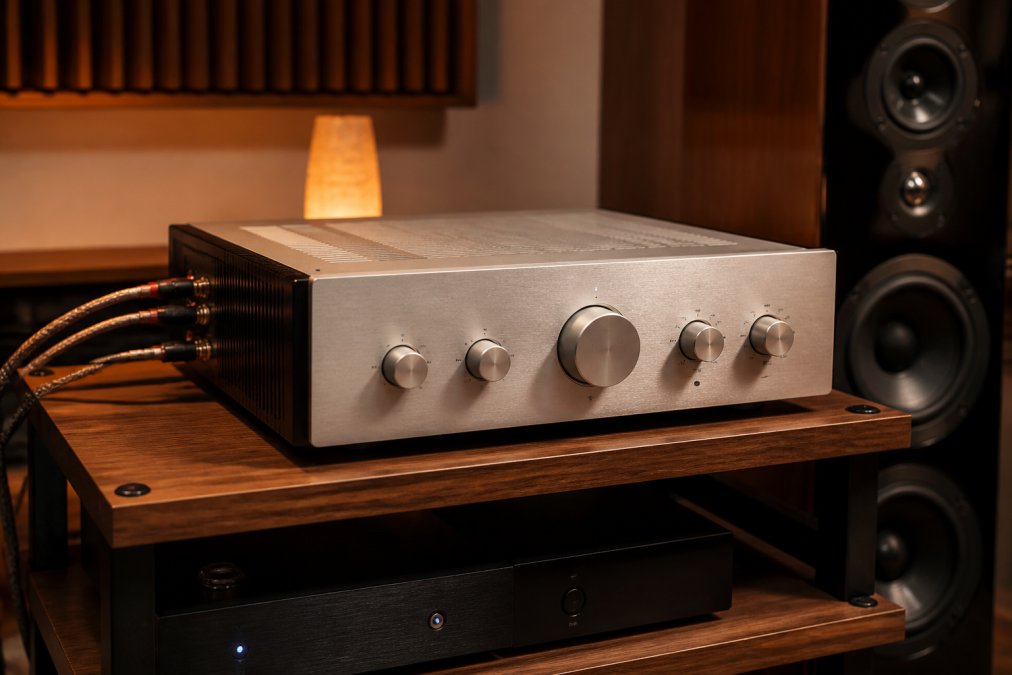
Wyred 4 Sound ST mkIII Series, Best Stereo Amp Under $2,000
The ST mkIII Series at $1,879 uses ICEpower's ICEedge topology paired with a third-generation input stage built around quad FET buffers and dual differential common mode converters. Available in three power levels (400W, 700W, and 1200W into 4 ohms), the ST mkIII scales to virtually any speaker load. music streaming services.
Best for: Audiophiles upgrading from mid-fi separates who want reference-grade stereo performance without the complexity of a monoblock setup.
Wyred 4 Sound STI-v2 Series, Best Integrated Amplifier for Purists
At $2,499, the STI-v2 combines a reference-quality analog preamp and two discrete mono amplifier stages into a single chassis. The ICE modules are borrowed directly from the award-winning ST mkII series. The STI-v2's Vacuum Fluorescent Display and optical rotary encoder give it a front panel built for decades of use.
Best for: Listeners who want a single, high-performance component rather than a preamp-plus-amplifier chain. Ideal for systems where simplicity and space are priorities without sacrificing resolution.
Wyred 4 Sound SX-1000R, Best Monoblock for Demanding Speakers
The SX-1000R ($1,499 per unit) is built for driving difficult speakers with total control. Stable down to 2 ohms, it handles the complex, phase-shifting loads that cause lesser amplifiers to clip or shut down.
Best for: Planars, electrostatics, and multi-driver towers with impedance dips below 4 ohms. Also the right choice for large listening rooms where sustained high-power output is required.
Wyred 4 Sound mAMP, Best Entry Monoblock for High-Fidelity Systems
The mAMP at $999 per unit uses the same third-generation input stage architecture as the larger models, scaled to a compact chassis that can be placed directly beside each speaker. Short speaker cables reduce resistance and capacitance in the final stage of the signal path, producing tighter bass and improved micro-dynamics. The mAMP has won recognition from Audiophilia and 6moons.
Best for: Audiophiles stepping into monoblock performance for the first time, or systems where speaker placement makes short cable runs practical.
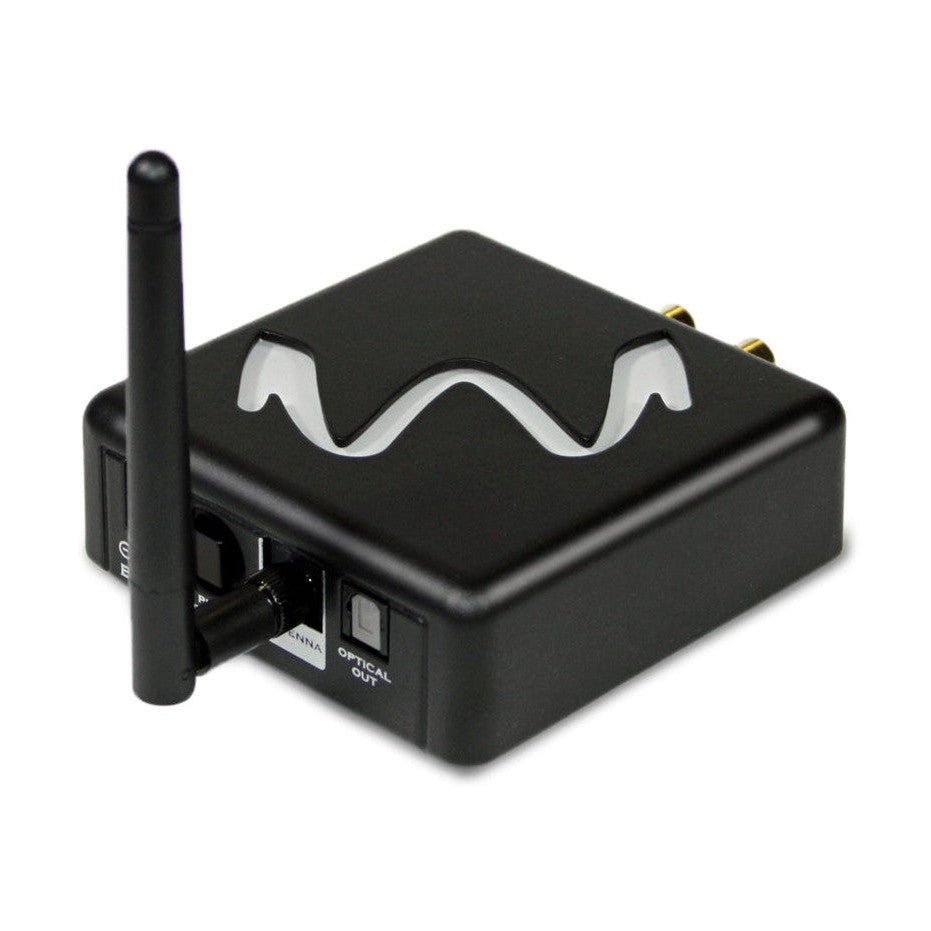
Wyred 4 Sound mINT, Best Compact Integrated with Built-In DAC
The mINT ($1,499) integrates a high-quality DAC, headphone amplifier, and power amplifier into a single unit. The ESS DAC supports 24-bit/192kHz via S/PDIF and 24-bit/96kHz via USB. On the amplification side, 100W per channel at 8 ohms is enough to control most bookshelf and moderate floor-standing speakers.
Best for: Listeners with smaller rooms or desktop systems who want a single component that handles digital conversion, headphone listening, and speaker amplification without a chain of boxes and interconnects.
High-End Audio Component Matching: Speakers, Sources, and Cabling
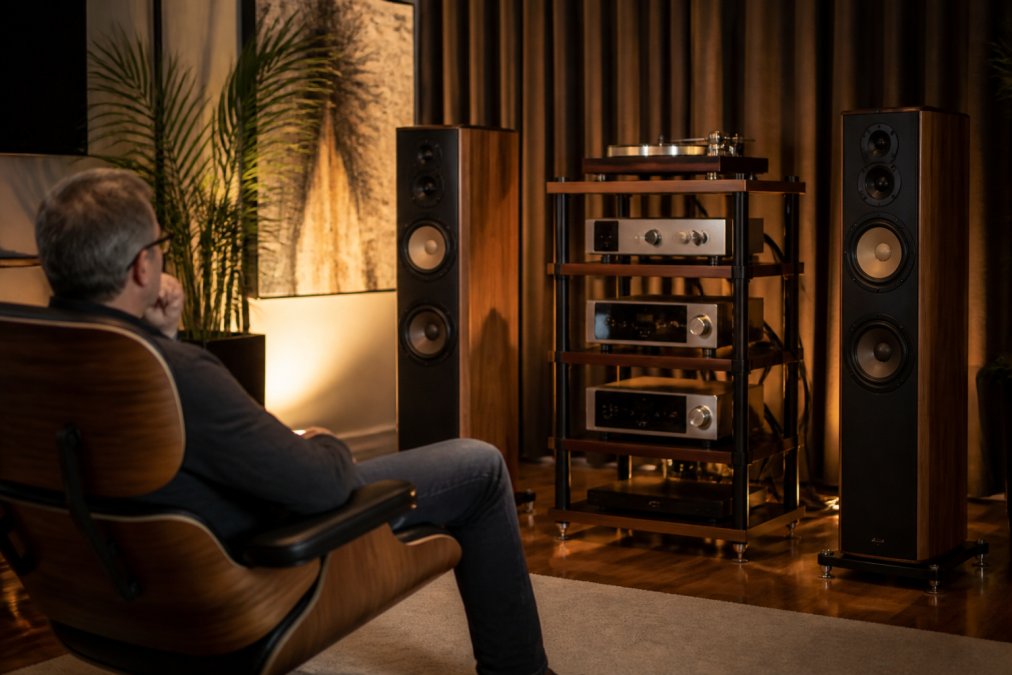
Component synergy is where high-end audio systems either cohere or collapse. The amplifier is only as good as what feeds it and what it drives.
Impedance Matching and Speaker Sensitivity
Most speakers are nominally rated at 8 ohms, but real-world impedance curves dip significantly at certain frequencies, sometimes to 2-3 ohms in the bass region. An amplifier that can't maintain current delivery into those dips will clip, compress, or shut down.
Speaker sensitivity, measured in dB at 1W/1m, determines how much power you actually need. A 90dB speaker requires roughly half the power of an 87dB speaker to reach the same volume. In a 12x14 foot room, 100W into an 88dB speaker is more than sufficient for reference listening levels (peer-reviewed research). For low-sensitivity speakers (below 86dB) or large rooms, the SX-1000R or ST mkIII at higher power configurations becomes the appropriate choice.
Acoustic Room Correction and System Integration
Room acoustics shape the perceived frequency response of any audio system more than the amplifier or speakers alone. Bass frequencies in particular accumulate at room boundaries, creating peaks and nulls that no amount of amplifier quality can overcome without acoustic treatment or digital correction. When integrating a Wyred 4 Sound amplifier into a corrected system, the amplifier's low output impedance and high damping factor work with the correction system rather than against it.
Power Efficiency, Heat Management, and Blind Test Methodology
Power efficiency in high-end amplifiers is no longer a compromise, it's an engineering advantage. Class D amplifiers operating above 90% efficiency generate a fraction of the heat produced by Class A or Class AB designs at equivalent power levels. Heat is the primary aging mechanism for capacitors, transistors, and solder joints. Wyred 4 Sound's ICEpower-based designs idle at under 10W and reach operating temperature quickly without thermal stress.
Properly controlled blind tests, where the listener doesn't know which component is playing, are the only reliable method for confirming audible differences. What blind testing consistently confirms: differences in distortion, noise floor, and frequency response extension are audible.
Which High End Amplifier Should You Buy?
The right amplifier depends on three variables: your speakers' impedance and sensitivity, your room size, and your preferred system architecture.
| Model | Price | Form Factor | Power | Best Match |
|---|---|---|---|---|
| ST mkIII Series | $1,879 | Stereo | 400-1200W (4 ohms) | Efficient to moderate speakers, mid-size rooms |
| STI-v2 Series | $2,499 | Integrated | 500-1000W (4 ohms) | Listeners wanting separates performance in one box |
| SX-1000R | $1,499/each | Monoblock | 1000W (4 ohms) | Difficult loads, large rooms, planars |
| mAMP | $999/each | Monoblock | 500W (4 ohms) | Entry monoblock, short cable runs |
| mINT | $1,499 | Integrated + DAC | 100W (8 ohms) | Small rooms, desktop, streaming-first systems |
If your speakers dip below 4 ohms: SX-1000R. Its stability at 2 ohms is the specification that matters.
If you want the simplest high-performance system: STI-v2. Reference preamp and dual mono amplification in one chassis, critically acclaimed, and genuinely efficient.
If budget is the priority without sacrificing monoblock architecture: mAMP pairs. Two units at $1,998 total outperform most stereo amplifiers at the same price point for demanding speaker loads.
If you're building a streaming-first system in a smaller room: mINT. The ESS DAC, headphone output, and 100W amplifier cover every modern use case in a single compact unit.
Every model in the lineup uses balanced circuitry that isolates impedance mismatches between components, meaning the amplifier performs consistently regardless of source component output impedance.
Frequently Asked Questions
Q: What are the top high end amplifier brands for home audio?
A: The best high end amplifier brands combine advanced topology, quality power supply design, and low harmonic distortion. Wyred 4 Sound stands out for its ICEpower-based Class D designs, earning awards from Audiophilia and 6moons. Their lineup spans from the mAMP monoblock at $999 to the STI-v2 integrated amplifier at $2,499, covering a wide range of audiophile system configurations.
Q: How do I choose between monoblock and stereo amplifiers?
A: Monoblocks dedicate a separate chassis and power supply to each channel, which reduces crosstalk and can improve soundstage imaging in demanding systems. Stereo amplifiers share a single chassis and power supply, making them more compact and cost-effective. For speakers with low impedance or high power demands, monoblocks like the Wyred 4 Sound SX-1000R ($1,499 each) offer greater headroom. Stereo amps like the ST mkIII Series ($1,879) suit most high-fidelity setups without the added complexity.
Q: Is Class D amplification good enough for high-end audio?
A: Modern Class D amplifiers, particularly those built on ICEpower and ICEedge topologies, deliver signal-to-noise ratios and damping factors that match or exceed many Class A and Class AB designs at a fraction of the heat output and power consumption. Wyred 4 Sound's Class D amplifiers have earned consistent praise from audiophile publications for transparency, transient response, and neutrality, demonstrating that Class D is no longer a compromise in high-fidelity systems.
Q: Are high end amplifiers worth the investment for a small listening room?
A: Yes. Room size affects speaker placement and acoustic treatment, but amplifier quality determines how cleanly and accurately the signal reaches your speakers regardless of room dimensions. A small 12x14-foot room benefits from a high-fidelity amplifier's low noise floor and controlled bass response. Compact options like the Wyred 4 Sound mINT ($1,499) integrate a DAC and amplifier in one chassis, making them well suited for smaller dedicated spaces without sacrificing audio resolution.
Q: What defines build quality in a high end amplifier?
A: Build quality in a high end amplifier covers the quality of internal wiring, binding posts, capacitors, and chassis rigidity. Wyred 4 Sound uses 14AWG OFC wiring soldered directly to gold-plated 5-way binding posts. Thermal management, short-circuit protection, and the robustness of the power supply design all determine how reliably an amplifier performs over years of continuous use.
Choosing a high end amplifier is easier when the specifications are transparent and the engineering is honest. Wyred 4 Sound publishes full specifications, supports its products domestically, and builds every amplifier to a standard that justifies the price. Explore the full lineup and find the model matched to your speakers and room at wyred4sound.com.