How to Calculate Amplifier Power Needs Step by Step
Quick Summary
Amplifier power needs depend on your speaker sensitivity, listening distance, target peak volume, and headroom for music peaks. Calculate the wattage by converting the total gain in decibels into a power multiplier applied to 1 watt.
- Each 3 dB increase in speaker sensitivity roughly halves the power needed for the same loudness.
- Sound pressure drops about 6 dB each time the listening distance doubles.
- Add 6 to 10 dB of headroom above your average listening level for music peaks.
- Every 10 dB of gain equals 10 times the power, so convert dB totals before choosing wattage.
- Treat the calculated result as a floor and confirm it with listening tests at your real volume.
Table of Contents
- How to Calculate Amplifier Power Needs Step by Step
- What Amplifier Power Needs Actually Depend On
- Understanding Speaker Sensitivity Ratings
- Calculating Target Listening Volume and Required Wattage
- Using a Speaker Wattage Calculator for Room Size
- Matching Amplifier Output to Speaker Ohms and Watts
- Headroom, Clipping and Choosing an Amplifier Power Calculator Result
- Putting Your Numbers to Work in Your Listening Room
- Frequently Asked Questions
How to Calculate Amplifier Power Needs Step by Step
Last Updated: November 19, 2026
What Amplifier Power Needs Actually Depend On
Choosing the right amplifier power starts with knowing what drives the number. A common mistake is picking a wattage from a spec sheet without checking how the speakers and room actually behave. Amplifier power needs depend on three things: how loud you want to listen, how efficient your speakers are, and how big and reflective your room is.
Speakers are the biggest variable. A speaker with high sensitivity turns a small amount of power into a lot of sound. A speaker with low sensitivity needs far more watts to reach the same volume. Your impedance also matters, because it changes how much current the amplifier must deliver.
Your listening habits matter just as much. Someone who listens to quiet jazz at conversation level has very different needs from someone who plays bass-heavy electronic music at party volume. Start by writing down three things: your speaker sensitivity, your listening distance, and the loudest level you want.
- Speaker sensitivity (rated in dB at 1 watt, 1 meter)
- Listening distance from speakers to your seat
- Peak volume you want in your room
- Speaker impedance (nominal ohms)
- Room size and how much sound it absorbs
Understanding Speaker Sensitivity Ratings
Speaker sensitivity is the single most useful number for amplifier sizing. It tells you how loud a speaker plays when driven with 1 watt measured at 1 meter. Manufacturers usually list it in decibels (dB), often between 84 dB and 95 dB for home speakers.
Each 3 dB increase in sensitivity roughly halves the power needed for the same loudness. A speaker rated at 92 dB needs about half the power of one rated at 89 dB to play equally loud. That is why two systems with the same amplifier can sound very different in volume.
A common mistake is treating sensitivity as a quality score. It is not. A high number just means the speaker converts power to sound efficiently. Check the spec sheet to see whether the rating was measured at 1 watt and 1 meter, because some makers use other conventions.
Calculating Target Listening Volume and Required Wattage
Once you know sensitivity, you can estimate the power needed for your target volume with a repeatable formula rather than a guess. The goal is to find the amplifier wattage that produces your desired peak sound pressure level (SPL) at the listening seat, then add headroom for music peaks.
The calculation has four inputs: speaker sensitivity in dB at 1 watt and 1 meter, listening distance in meters, target peak SPL at the seat in dB, and a headroom allowance in dB. The formula is:
Required power (watts) = 10^((target SPL − sensitivity + distance loss + headroom) / 10)
Distance loss follows the inverse-square law: SPL drops about 6 dB each time the distance doubles. From 1 meter to 2 meters is −6 dB, to 4 meters is −12 dB, and to 8 meters is −18 dB. For a seat at 3 meters, the loss is roughly 9.5 dB, which most practitioners round to 9 or 10 dB for planning.
Here is the step-by-step workflow:
- Pick your target peak SPL at the listening seat. For most home listening, 85 to 95 dB peaks feel loud but natural; 100 dB and above is party or home-theater level.
- Note your speaker's sensitivity, such as 90 dB at 1 watt and 1 meter.
- Calculate distance loss from 1 meter to your seat using the inverse-square rule.
- Add your headroom allowance, typically 6 to 10 dB for music peaks.
- Combine the terms and convert the dB total to a power multiplier, where every 10 dB equals 10× power and every 3 dB roughly doubles it.
- Multiply 1 watt by that multiplier to get the estimated wattage.
Worked Example: A Typical Listening Room
Consider a 12 by 14 foot room with speakers rated at 90 dB (1 W/1 m), sitting 3 meters from the speakers. You want peaks of 95 dB at the seat.
- Target SPL: 95 dB
- Sensitivity: 90 dB
- Distance loss at 3 meters: about 9.5 dB
- Headroom: 6 dB
- Total gain needed: 95 − 90 + 9.5 + 6 = 20.5 dB
Convert 20.5 dB to a power multiplier: 10^(20.5/10) = 10^2.05 ≈ 112. So you need roughly 112 watts to hit 95 dB peaks at 3 meters with 6 dB of headroom. Without the headroom term, the same setup needs about 28 watts, which shows why the headroom allowance dominates the result.
Watch out: if you skip the distance term, you will undersize the amplifier by roughly 10 dB, which is a 10× power error at a 3-meter seat. Always convert distance to dB before converting to watts.
A common pattern is to run the formula twice: once for average listening level and once for peak level, then size the amplifier to the peak result. That keeps the average level well within the amplifier's clean operating range and leaves the peaks covered.
The article's calculation workflow can be summarised as a set of steps with the key inputs and their typical values.
| Step | What to do | Typical value |
|---|---|---|
| 1. Target peak SPL | Pick the peak level at the seat | 85 to 95 dB for home listening |
| 2. Sensitivity | Note the speaker's rating at 1 W / 1 m | 84 to 95 dB |
| 3. Distance loss | Apply inverse-square rule to the seat | About 6 dB per doubling |
| 4. Headroom | Add allowance for music peaks | 6 to 10 dB |
| 5. Convert to power | Turn the dB total into a multiplier | Every 10 dB = 10× power |
| 6. Result | Multiply 1 watt by the multiplier | 112 W in the worked example |
Using a Speaker Wattage Calculator for Room Size
A speaker wattage calculator speeds up the math. Most tools ask for sensitivity, impedance, listening distance, room size, and target SPL, then return a recommended wattage. A good amplifier power calculator also shows the formula so you can check the result.
Room size changes the answer. Small rooms reflect sound and reach high levels with less power. Large or heavily treated rooms absorb energy and need more. For a room under 200 square feet, expect modest power needs. Larger dedicated listening rooms usually call for more headroom.
When you use a calculator, enter your real numbers, not hopes. Test the output by asking whether the recommended power would reach your target SPL without strain.
Matching Amplifier Output to Speaker Ohms and Watts
Matching ohms and watts keeps the system safe and sounding right. Speaker impedance is the load the amplifier sees. Most home speakers are rated at 4 to 8 ohms, though some dip lower in certain frequencies. Lower impedance draws more current, so the amplifier must be able to supply it.
Check the amplifier's rated output at your speaker's impedance. An amplifier may deliver 100 watts into 8 ohms and considerably more into 4 ohms. Look for stability at low impedance if your speakers dip below 4 ohms.
Speaker power handling is the other half. Choose an amplifier whose continuous output sits within the speaker's rated power range. Running a speaker with far more power than it can handle risks damage, so match both figures.
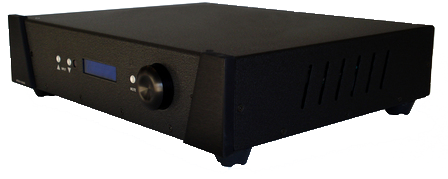
For a well-matched pairing, consider our STI-v2 Series, an integrated amplifier with 2 power configurations that suits many speaker and room combinations. Browse our power amps to compare output ratings against your speaker specs.
Headroom, Clipping and Choosing an Amplifier Power Calculator Result
Headroom is the reserve power that lets music peaks pass cleanly. Music is dynamic, so brief peaks can demand several times the average power. An amplifier pushed to its limit clips, which turns the waveform flat and adds harsh distortion that can damage tweeters.
Give yourself at least 6 to 10 dB of headroom above your average listening level. If your calculator says 60 watts, a 100-watt amplifier gives a safe margin. Treat the calculator result as a floor, not a target. A common pattern is to size for peak SPL plus 6 dB, then confirm the amplifier's continuous rating at your speaker's impedance meets that number.
Watch out: simply choosing a much larger amplifier is not automatically safer. A 500-watt amplifier driven into clipping at high volume can still damage speakers, and an oversized amplifier raises the risk of thermal or mechanical damage if the volume is pushed past the speaker's limits. The safe approach is to match the amplifier's clean output to the speaker's continuous power rating and your peak SPL target, not to maximize wattage.
Sensitivity conventions affect the result more than most buyers realize. A rating of 90 dB at 1 W/1 m and a rating of 90 dB at 2.83 V/1 m are not the same measurement. The 2.83 V convention delivers 1 watt into 8 ohms but 2 watts into 4 ohms, so a 4-ohm speaker rated at 2.83 V/1 m will appear about 3 dB more sensitive than its 1 W/1 m equivalent.
Multi-channel amplifiers add another wrinkle. Per-channel ratings are often quoted with one channel driven. When all channels run simultaneously, shared power supplies and heat limits can reduce the per-channel output, sometimes by 20 to 30 percent. Read the continuous versus peak specifications and look for a rating that states the number of channels driven. If the spec sheet only lists a single-channel figure, assume the all-channel number is lower and size accordingly.
Finally, treat the calculator result as a starting point for listening tests. Run the system at your real volume, listen for harshness or compression at peaks, and adjust upward only if the amplifier shows strain.
Putting Your Numbers to Work in Your Listening Room
Now bring the steps together. Write down your speaker sensitivity, impedance, listening distance, target SPL, and room size. Run the calculation, add headroom, and check the result against the amplifier's rated output at your impedance.
Once you have a target wattage, shop the amplifiers category for models that meet or exceed it with room to spare. Pick a unit that fits your speakers and your listening habits, not just the lowest number on the sheet.
Your final numbers are a starting point. Listen at your real volume, confirm there is no strain at peaks, and adjust if needed. A well-sized amplifier delivers clean sound at the volume you actually enjoy.
Frequently Asked Questions
How much amplifier power do I need?
Start with your speakers' sensitivity rating, typically listed in decibels at 1 watt and 1 meter, and your target listening level, often around 85 to 95 decibels at your listening position. Each 3 decibel increase in sound pressure level roughly doubles the power required, so a speaker rated 86 decibels needs about 8 times more power to reach 95 decibels than it needs to reach 86. Add 6 to 10 decibels of headroom for dynamic peaks in music, which typically means choosing an amplifier rated well above the calculated minimum.
What size amp do I need for 400-watt speakers?
A speaker's power handling rating is not the amount of power you need to drive it. Power handling describes how much continuous power the speaker can tolerate without damage. Most listening rooms reach comfortable levels with far less, so an amplifier rated around 100 to 200 watts per channel into the speaker's impedance is often sufficient, depending on sensitivity. Use the sensitivity-based calculation rather than the power handling number to size the amplifier.
Does a larger room require a more powerful amplifier?
Yes, because sound pressure falls off with distance from the speakers, so a larger room or longer listening distance requires more output to reach the same level at your seat. Doubling the listening distance reduces sound pressure by about 6 decibels in a free field, meaning you need roughly four times the power to compensate. Room boundaries and furnishings also change the result, so treat calculated values as a starting point and confirm by listening.